
Blog: Hard choices
There are no painless options for the prime minister to resolve the prison capacity crisis, warns PRT’s deputy director Mark Day.
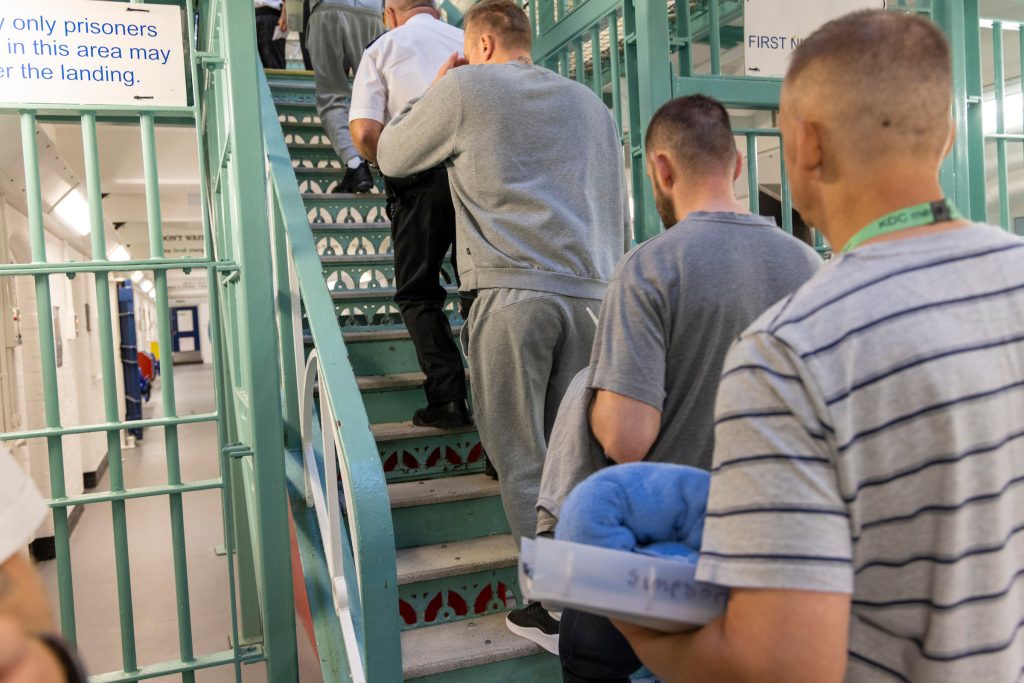
Andy Burnham may not have wanted his first week as prime minister to be dominated by the issue of the early release of prisoners. But his decision to pause the scheme and introduce exemptions means that responsibility for the consequences now rests with him.
The earlier release of prisoners serving standard determinate sentences may not be politically palatable, but the policy was not devised on a whim. It followed detailed consultation through the independent sentencing review and a substantial process of legislative scrutiny and debate in Parliament.
And it is worth remembering why the legislation was introduced in the first place: to address the very real prospect of a prison-capacity crisis in the years ahead.
The government has committed to delivering an additional 14,000 prison places by 2031. But the Ministry of Justice’s prison population projections show that these places cannot be built quickly enough to accommodate the projected rise in the number of prisoners. The population is predicted to rise from 86,500 today to a central estimate of 100,600 by 2030.
Prison numbers have been rising steeply since 2022, driven by sentence inflation, a growing remand and recall population, increases in arrests and convictions, and the ending of Covid-19 public-health restrictions. In 2023, numbers came dangerously close to overwhelming the criminal justice system, necessitating a series of emergency measures.
One such measure, introduced when there were fewer than 200 spare places across the entire prison estate, was the use of police cells to hold remanded and sentenced prisoners. At one point, police cells became so full that forces were at risk of having nowhere to put people they had arrested, including those accused of serious violent and sexual offences.
Failing to take difficult decisions to ease pressure on prisons would have condemned the system to a perpetual cycle of overcrowding, emergency measures and short-term fixes for the remainder of the decade.
Following weeks of negative headlines, Andy Burnham’s determination to introduce further exemptions to earlier release may be politically understandable. But every exemption reduces the prison-capacity savings that the legislation was designed to deliver. The more those savings are eroded, the greater the risk that the system will once again be forced into emergency measures.
The prime minister has therefore tasked his new justice secretary, Alex Norris, with finding other ways to make up for the capacity lost through these exemptions.
Among the ideas floated are imprisoning fewer women, potentially freeing up a women’s prison to house men; the quicker removal of foreign national prisoners; and reviewing the position of prisoners serving Imprisonment for Public Protection — the discredited IPP sentence — with a view to releasing more of those still in custody.
None of these offer an easy solution. Also missing from the prime minister’s suggestions are some potentially more straightforward options to deliver capacity savings. Further measures to limit the use of recall and tackle the growing remand population could offer more sustainable routes to freeing up capacity than those currently under consideration. The government could also reconsider its decision to remove adult standard determinate sentenced prisoners from the home detention curfew scheme as part of the new earned progression model.
Reducing the women’s prison population has been a stated ambition of successive governments, yet numbers have failed to fall by anything like the scale required to make a meaningful difference to overall capacity. Even if an entire women’s prison could be repurposed for men, the gains would be relatively modest given the size of the women’s estate.
There would also be a significant social cost. Women are already held, on average, much further from home than men. Repurposing a women’s prison to relieve pressure in the male estate would increase that disparity, potentially undermining family contact and effective resettlement after release.
The quicker removal of foreign national prisoners offers some scope for relieving pressure, but it is not a solution that can simply be scaled up at will. The Sentencing Act has already gone further than previous rules, allowing eligible foreign national prisoners serving determinate sentences to be removed for immediate deportation at any point after sentence. But deportation remains subject to legal and practical constraints, including exceptions where removal would breach ECHR or Refugee Convention obligations.
The question is therefore less whether ministers can remove foreign national prisoners earlier — the legislation now provides for that — than how many additional prisoners can actually be removed, and how quickly.
The IPP option presents an even more complex set of issues for the government to address. There is undoubtedly more that could be done to reduce the number of IPP prisoners recalled to custody and to progress the cases of those who have never been released. At the end of March 2026, there were 896 unreleased IPP prisoners, alongside a much larger population of IPP prisoners who had been released but subsequently recalled.
Greater use of existing mechanisms could produce some capacity savings, but a much larger reduction would require the government to legislate. IPP sentences were abolished in 2012, but the change was not retrospective: prisoners already serving IPPs remain subject to the sentence and can continue to be held after the expiry of their original tariff based on an assessment of risk by the Parole Board.
Any legislation would require time for parliament to debate and enact; time the government may not have if it is to head off the prospect of a capacity crisis in the near future. It would need to weigh the injustice of the IPP sentence against public protection concerns. The government has to decide how far it is prepared to go.
The answer to this question matters because the government is now attempting to reconcile two competing political demands.
On the one hand, there is the understandable public desire for punishment, justice and public protection. On the other, there is the practical reality that prisons have finite capacity, and that capacity cannot be wished into existence simply because releasing prisoners early has become politically uncomfortable.
The government’s U-turn on early release in the face of the public backlash does not suggest that it has resolved this tension. It suggests that it has postponed it. And that leaves the new prime minister’s wider priorities for prison reform looking increasingly uncertain.
The troubling impression is that the government may not yet have decided which difficult choice it is prepared to make. It may simply be trying to survive the next negative headline.
But prison policy cannot be governed by the news cycle. Sooner or later, the government will have to confront the arithmetic — and decide what it is actually prepared to sacrifice to solve the problem it inherited.
Mark Day
Deputy Director
